


Snowball Earth
Syllabus: GS1/ Physical Geography
Context
- Recently scientists studied rocks on the Garvellach Islands in Scotland to understand the Snowball Earth period.
What is Snowball Earth?
- Snowball Earth refers to episodes when Earth’s surface was almost entirely covered by ice, including oceans and tropical regions. It occurred mainly during the Cryogenian Period (720-635 million years ago).
- It was triggered by feedback mechanisms such as increased ice cover raising Earth’s albedo (reflectivity) and reduced solar heat absorption, causing further cooling.
- The possible causes include continental configurations near the equator, reduced greenhouse gases, and volcanic activity patterns.
Source: TH
Iran Shuts Strait of Hormuz
Syllabus: GS1/Geography
In News
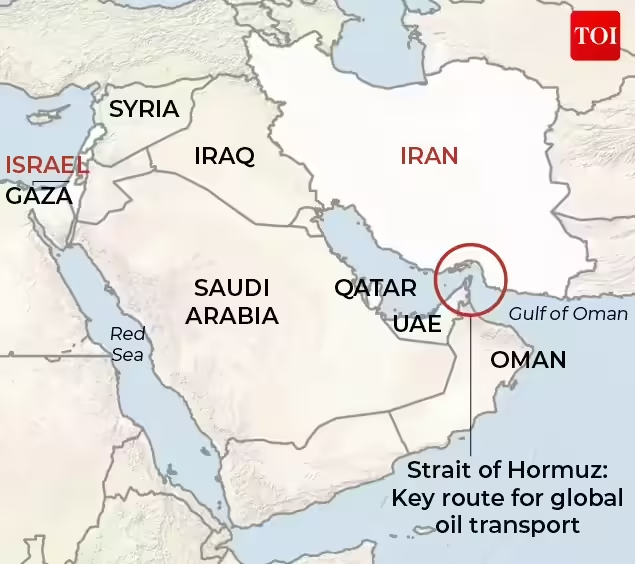
- Iran temporarily closed parts of the Strait of Hormuz, through which about 20% of the world’s oil passes, during live-fire drills as tensions with the US escalated amid nuclear talks in Geneva.
About the Strait of Hormuz
- The Strait of Hormuz lies between Iran to the north and Oman and the United Arab Emirates to the south, linking the Persian Gulf with the Gulf of Oman and the Arabian Sea.
- At its narrowest point it is about 33 kilometres wide, with shipping lanes just a few kilometres across in either direction.
- Nearly half of India’s crude oil and around 60 per cent of its natural gas imports pass through the strait.
Do you know?
- Iran has previously threatened to close the Strait — during the Iran-Iraq “Tanker War” (1980s) and in response to sanctions in 2012 — but has never fully implemented a complete shutdown.
- Although Saudi Arabia and the UAE have developed pipelines bypassing the strait, these routes can carry only a limited portion of the total oil volume transiting Hormuz.
Source: TOI
Closure of FRA Cells in Odisha Triggers Central Scrutiny
Syllabus: GS2/ Governance
Context
- The Union Ministry of Tribal Affairs has initiated inquiries into the directives given by the State government of Odisha to shutdown of Forest Rights Act (FRA) Cells at multiple administrative levels.
The Forest Rights Act (FRA), 2006
- The Forest Rights Act (FRA), 2006 legally recognizes the rights of Scheduled Tribes and Other Traditional Forest Dwellers (OTFDs) to manage, conserve, and use forest resources sustainably.
- It recognizes and vests individual and community forest rights (CFRs) in Scheduled Tribes (STs) and other traditional forest dwellers (OTFDs) who have lived in forests for generations but whose rights were never formally recorded.
- The Act also empowers Gram Sabhas to:
- Identify and verify claims over forest land and resources.
- Manage and protect forest resources sustainably.
- Regulate access to Minor Forest Produce (MFP) such as bamboo, tendu leaves, lac, honey, and wax.
- Role of FRA Cells: These are special administrative units created to accelerate FRA implementation. Its functions includes;
- Assisting claim filing and verification.
- Maintaining records and digitisation of titles.
- Providing technical and field support to local authorities.
Source: TH
VoicERA Launched on BHASHINI National Infrastructure
Syllabus:GS2/Governance
In News
- The Digital India BHASHINI Division (DIBD), under the Digital India Corporation (DIC), Ministry of Electronics and Information Technology (MeitY) launched VoicERA.
VoicERA
- It is an open source, end to end Voice AI stack which is deployed on the BHASHINI National Language Infrastructure.
- It establishes a national execution layer for multilingual Voice and Language AI.
- It is designed to be open, pluggable, interoperable, cloud deployable, and on premise ready.
- It enables secure and scalable deployment of voice systems across government, research institutions, and innovation ecosystems.
- It reduces duplication of effort and eliminates vendor lock in by modularising the voice stack.
Importance
- The integration of VoicERA with BHASHINI transforms India’s national language infrastructure into a voice-enabled Digital Public Infrastructure, supporting real-time speech, conversational AI, and multilingual telephony at population scale.
- It enables government departments to quickly deploy voice-based citizen services across sectors like agriculture, education, livelihoods, grievance redressal, and scheme discovery, promoting inclusive, secure, and interoperable public service delivery.
Source :PIB
Food Corporation of India (FCI) and the World Food Programme (WFP)
Syllabus: GS3/ Economy
In News
- The Food Corporation of India (FCI) and the World Food Programme (WFP) have signed a Memorandum of Understanding (MoU) for the supply of rice in support of global humanitarian operations aimed at combating hunger.
- The World Food Programme was established in 1961, serves as the United Nations’ primary food-assistance branch and the world’s largest humanitarian organization focused on combating hunger and enhancing global food security.
About Food Corporation of India (FCI)
- FCI is a statutory body established under the Food Corporations Act, 1964 and functioning under India’s Ministry of Consumer Affairs, Food and Public Distribution.
- Its core genesis stems from the need to manage food shortages, particularly wheat, by implementing effective price support for farmers through Minimum Support Prices (MSP).
- It ensures national food security via procurement, storage, distribution under the Public Distribution System (PDS), and buffer stock management for contingencies like droughts or floods.
- Headquartered in New Delhi.
Source: PIB
Municipal Bonds
Syllabus: GS3/ Economy
In News
- The Ministry of Housing and Urban Affairs (MoHUA) recently organized a high-level consultation to deepen India’s municipal bond market, aligning with efforts to boost urban infrastructure financing.
About Municipal Bonds
- Municipal bonds are marketable debt instruments issued by ULBs, either directly or via intermediaries like corporate municipal entities or special purpose vehicles.
- First issued by Bengaluru in 1997, they finance capital projects (e.g., water supply, sewerage), refinance loans, and cover working capital needs.
- Regulated by SEBI’s Issue and Listing of Municipal Debt Securities Regulations, 2015, they offer tax-free interest, attracting investors while supporting fiscal decentralization.
Source: AIR
Project Vault
Syllabus: GS3/Economy
Context
- The United States unveiled Project Vault, an independently governed and operated public-private partnership.
About
- It is aimed at establishing a strategic domestic reserve of critical minerals in the United States.
- The partnership is backed by $10 billion in financing by the Export-Import Bank of the United States (EXIM) and an additional $2 billion in private funds.
- This stockpile build-up represents a whole-of-government transformative approach to reduce dependence on foreign-controlled supply chains.
- Project Vault is intended to function as a long-term insurance for domestic manufacturers, who could procure minerals without geographic restrictions, based on supply availability and commercial considerations, and store them.
What are Critical Minerals?
- Critical minerals are elements that are the building blocks of essential modern-day technologies, and are at risk of supply chain disruptions.
- The lack of availability of these minerals or the concentration of extraction or processing in a few geographical locations could potentially lead to “supply chain vulnerabilities and even disruption of supplies”.
Applications of Critical Minerals
- Clean technologies initiatives such as zero-emission vehicles, wind turbines, solar panels etc.
- Critical minerals such as Cadmium, Cobalt, Gallium, Indium, Selenium and Vanadium and have uses in batteries, semiconductors, solar panels, etc.
- Advanced manufacturing inputs and materials such as defense applications, permanent magnets, ceramics.
- Minerals like Beryllium, Titanium, Tungsten, Tantalum, etc. have usage in new technologies, electronics and defense equipment.
- Platinum Group Metals (PGMs) are used in medical devices, cancer treatment drugs, and dental materials.
List of Critical Minerals
- Different countries have their own unique lists of critical minerals based on their specific circumstances and priorities.
- A total of 30 minerals were found to be most critical for India: Antimony, Beryllium, Bismuth, Cobalt, Copper, Gallium, Germanium, Graphite, Hafnium, Indium, Lithium, Molybdenum, Niobium, Nickel, PGE, Phosphorous, Potash, REE, Rhenium, Silicon, Strontium, Tantalum, Tellurium, Tin, Titanium, Tungsten, Vanadium, Zirconium, Selenium and Cadmium.
Source: TH
Bhirrana Site
Syllabus: GS1/Ancient History
Context
- The research suggests the Indus Valley Civilisation could be far older than previously believed, not just by a few centuries, but by thousands of years.
About
- Experts studying pottery and animal remains at Bhirrana in northern India suggest that the Indus Valley Civilization may stretch back around 8,000 years.
- If confirmed, that would place its earliest beginnings well before the era of Egypt’s first pharaohs.
- For decades, historians have placed the great civilisations of the ancient world in an order from first Mesopotamia, then Egypt with its pyramids and pharaohs, and alongside them, the Indus Valley Civilisation.
Indus Valley Civilization
- The Harappan civilization is believed to be one of the oldest world civilizations that flourished roughly between 2600 and 1900 BC.
- It was developed along the river Indus and for that reason it is also known as the Indus Valley Civilization.
- At its height, it covered vast areas of what is now Pakistan and north-west India.
- It is identified as a Bronze-age civilization because many objects have been found that are made up of copper based alloys.
Major Harappan Sites
| Site | Present Day |
| Harappa | Punjab, Pakistan |
| Mohenjo-Daro | Sindh, Pakistan |
| Dholavira | Kutch district of Gujarat, |
| Kalibangan | Rajasthan |
| Lothal | Gujarat |
| Rakhigarhi | Haryana |
| Chanhudaro | Sindh, Pakistan |
| Ganweriwala | Punjab, Pakistan |
| Sutkagendor | Baluchistan Province, Pakistan |
| Alamgirpur | Uttar Pradesh |
Source: TOI
Kerala Cabinet Gives Nod for Bill to Issue Nativity Cards
Syllabus: GS2/Governance
In News
- Kerala Cabinet approves Nativity Card Bill to provide residents with an official document for government services and social purposes.
Kerala Nativity Card Bill
- It allows the State government to issue Nativity Cards as authoritative documents for accessing government services and other social purposes.
- The card, modeled on the existing Nativity Certificate, will be photo-affixed and permanent.
- The Bill defines a native as someone born in Kerala who has not taken foreign citizenship, or someone with a Kerala-born ancestor who retained Indian citizenship.
- People born outside Kerala to Keralite parents for livelihood reasons are also eligible.
- Those who relinquish citizenship after receiving the card will have it nullified.
Source :TH
Previous article
India’s Drone Ecosystem
Next article
Google’s America-India Connect Initiative
